The short answer
Japanese people don't expect visitors to know every rule, and they are very forgiving. But five things really matter: take your shoes off where there is a step up, don't tip, no phone calls on trains, carry your rubbish and wash before getting into an onsen. The best trick of all? Watch what the people around you do, and do the same.
Shoes, homes and ryokan
1. Take your shoes off where there is a step up
At homes, ryokan, many temples, some restaurants and even fitting rooms, there is an entrance area (genkan) one step lower than the floor. Shoes stay there, toes pointing to the door; you step up in socks or the slippers provided. Never walk on tatami mats in slippers: socks or bare feet only. Wear socks without holes and shoes that are easy to slip on and off.
2. Use the toilet slippers, and only there
Many homes and ryokan have special slippers inside the toilet. Change into them at the door and change back when you leave: walking out into the corridor or the dining room in toilet slippers is the classic tourist mistake (and everyone notices).
Money and greetings
3. Don't tip
Tipping is not part of the culture and can cause embarrassment: staff may run after you to return the money. Good service is included. In restaurants and shops put your cash or card on the small tray by the till instead of handing it over.
4. A small bow goes a long way
Nobody expects a perfect bow from a visitor, but a slight nod of the head when you say thank you (arigatō gozaimasu), greet someone or apologise is always appreciated. Handshakes are fine with business people; hugs and back-slaps are not.
At the table
5. Chopsticks: two things you must never do
Never stick chopsticks upright in a bowl of rice and never pass food from chopsticks to chopsticks: both recall funeral rites. Also avoid pointing with them, licking them or rubbing disposable ones together. When you pause, lay them on the rest or across your bowl.
6. Slurp your noodles, but don't blow your nose
Slurping ramen or soba is normal and shows you're enjoying it. Blowing your nose at the table is not: step outside or to the toilet. Use the oshibori (wet towel) for your hands only, not your face. Say itadakimasu before eating and gochisōsama deshita when you leave: more in our restaurant phrases guide.
Trains and streets
7. Be quiet on trains and buses
No phone calls on public transport: set your phone to silent ("manner mode"). Talk quietly, keep your backpack on your front or on the rack and leave priority seats to people who need them. Eating is fine on the shinkansen and long-distance trains, but not on local commuter trains.
8. Queue, and stand on the right side of the escalator
People line up in neat rows on the platform markings. On escalators, the unwritten rule is to stand on the left in Tokyo and on the right in Osaka, although stations now ask everyone to stand on both sides and not walk: follow what locals around you do.
9. Don't eat while walking
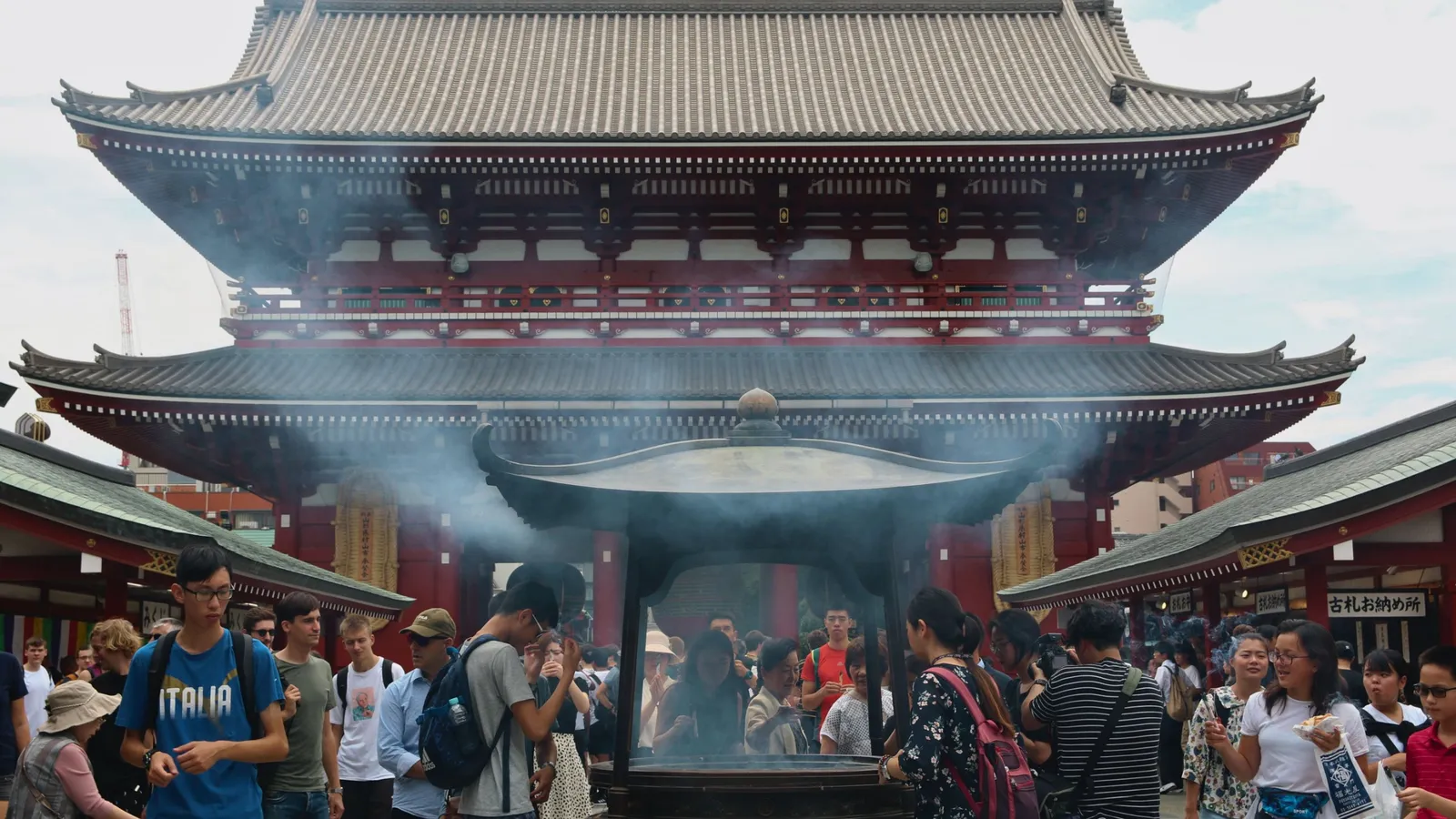
In many places, eating and drinking while walking down the street is frowned upon, and some busy streets near temples (for example in Kamakura and around Asakusa) ask visitors not to. Eat next to the stall or vending machine where you bought it.
10. Carry your rubbish with you
Japan is spotless but has very few public bins. Keep a small bag for your trash and throw it away at your hotel, at a convenience store bin (when you buy something there) or at stations. Separate burnable, plastic and bottles/cans where bins are marked.
Temples and onsen
11. At shrines: purify, bow, clap
At the chōzuya water basin rinse your left hand, then your right, then pour a little water into your left hand to rinse your mouth (don't drink from the ladle). At a Shinto shrine the prayer is: bow twice, clap twice, pray, bow once. At a Buddhist temple you don't clap: just put your hands together quietly. Walk on the sides of the path, not the centre.
12. Onsen: wash first, no swimsuit, no towel in the water
In hot springs and public baths you bathe naked, separated by gender. Wash and rinse thoroughly at the shower stools before getting in; keep the small towel out of the water (people put it on their head). Tie up long hair. Many baths still refuse tattoos: check in advance or look for "tattoo friendly" baths or private baths (kashikiri).
People and space
13. Ask before photographing people
Never photograph geisha or maiko as if they were an attraction, and don't follow them. In Kyoto's Gion, signs warn of fines of up to ¥10,000 for entering or taking photos on private lanes. Respect "no photo" signs in temples, shops and restaurants too.
14. Mind your volume and your space
Japanese public spaces are calm. Avoid loud groups on the street at night, don't block narrow pavements with big suitcases (use luggage forwarding, takkyūbin) and don't sit on temple steps or walls where it's not allowed.
15. Wear a mask if you have a cold
Wearing a mask when you're coughing or sneezing is seen as basic consideration for others. Nobody minds if you wear one; many people will mind if you cough openly on a crowded train.
The cheat sheet
| Do ✅ | Don't ❌ |
|---|---|
| Shoes off where there's a step up | Slippers on tatami |
| Money on the tray | Tipping |
| Slurp your noodles | Chopsticks standing in rice |
| Phone on silent | Calls on the train |
| Rubbish in your bag | Eating while walking |
| Wash before the onsen | Towel in the water |
| Ask before photos | Chasing geisha in Gion |
Japan's rules, in your pocket.
687 Japan plans your trip by stages with trains, the offline map, earthquake and weather alerts and useful phrases ready to show. If something changes, NOW rebuilds the rest of the day.
Sources
- Japan National Tourism Organization – Japanese manners do's and don'ts
- JNTO – Japanese customs and etiquette (responsible travel)
- Japan Tourism Agency – Responsible traveler
- Kyoto City official travel guide
Checked against these official sites in November 2026. Prices and rules can change: always confirm before you travel.